


Goddess Lada

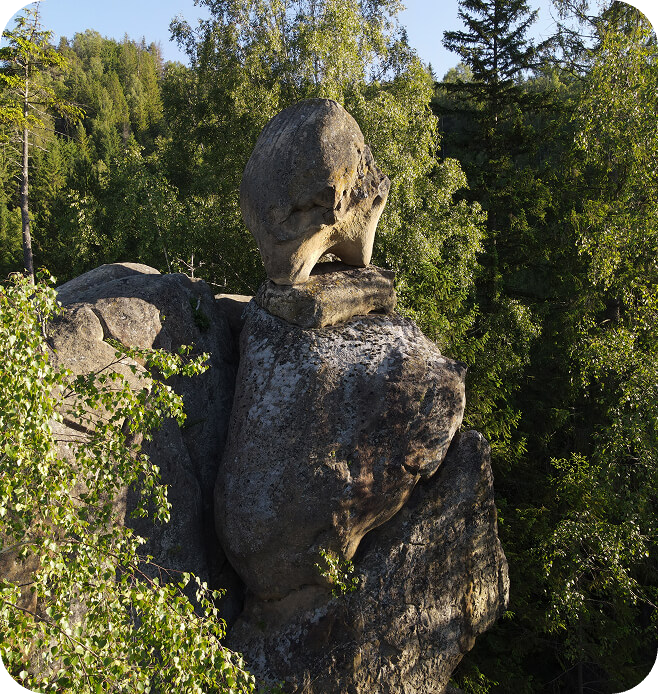
The most famous megalith of the sanctuary is a 10-meter-tall anthropomorphic figure, associated with the Great Primordial Mother – the goddess Lada. She is depicted with broad feminine hips, a pregnant belly, milk-filled breasts, her right hand resting between chest and womb, a straight back, and a head with four faces gazing toward the four cardinal directions. The head rests on three supporting legs, with the neck serving as a pedestal that transitions into a square-shaped neck ornament. Slightly leaning back, the woman gazes toward the east.
Researchers believe that the figure’s posture and the shape of her belly indicate that this was an ancient astronomical observatory. As noted by scholar Lyubomyr Derzhypilsky in his book, the apex of the triangular belly and the head are aligned with the point of sunrise at the equinox, while the angle between the left and right planes of the belly encompasses the sector where the sun rises throughout the year. Thus, Lada – pregnant with the sun – seems to embrace the space where the sun is born.
Who is Lada in Slavic tradition?
Lada’s name is linked to the Slavic word lad — harmony, concord, order — and to the refrain lado (“dear”, “beloved”) heard in Ukrainian and other Slavic songs. As a goddess of spring, love and marriage, Lada first appears in Polish sources of the 15th century: early-15th-century sermons and the chronicle of Jan Długosz. Later, the Hustyn Chronicle names Lado as a god of weddings, joy and prosperity.
Scholars still debate whether Lada was a genuine ancient deity. Alexander Potebnja, Max Vasmer and others argued that scribes mistook the song refrain for a divine name, while Boris Rybakov defended her cult. Either way, Lada remains a powerful image of spring, love and family in Slavic culture.
Why the rock is called Lada
The 10-metre rock figure near Snidavka received the name Lada in modern tradition: people saw in its shape a pregnant woman, a Great Mother. In the interpretation of researcher Mykola Kuhutiak, whose expedition studied the site in 2006–2007, the figure is the central part of an ancient rock sanctuary alongside a stone circle, a phallic stone and a chthonic serpent. The dating of any human work on the stone remains debated.
Curious about the popular amulet? Read Star of Lada: meaning and origin. Planning a visit? See how to get to Ternoshorska Lada.