


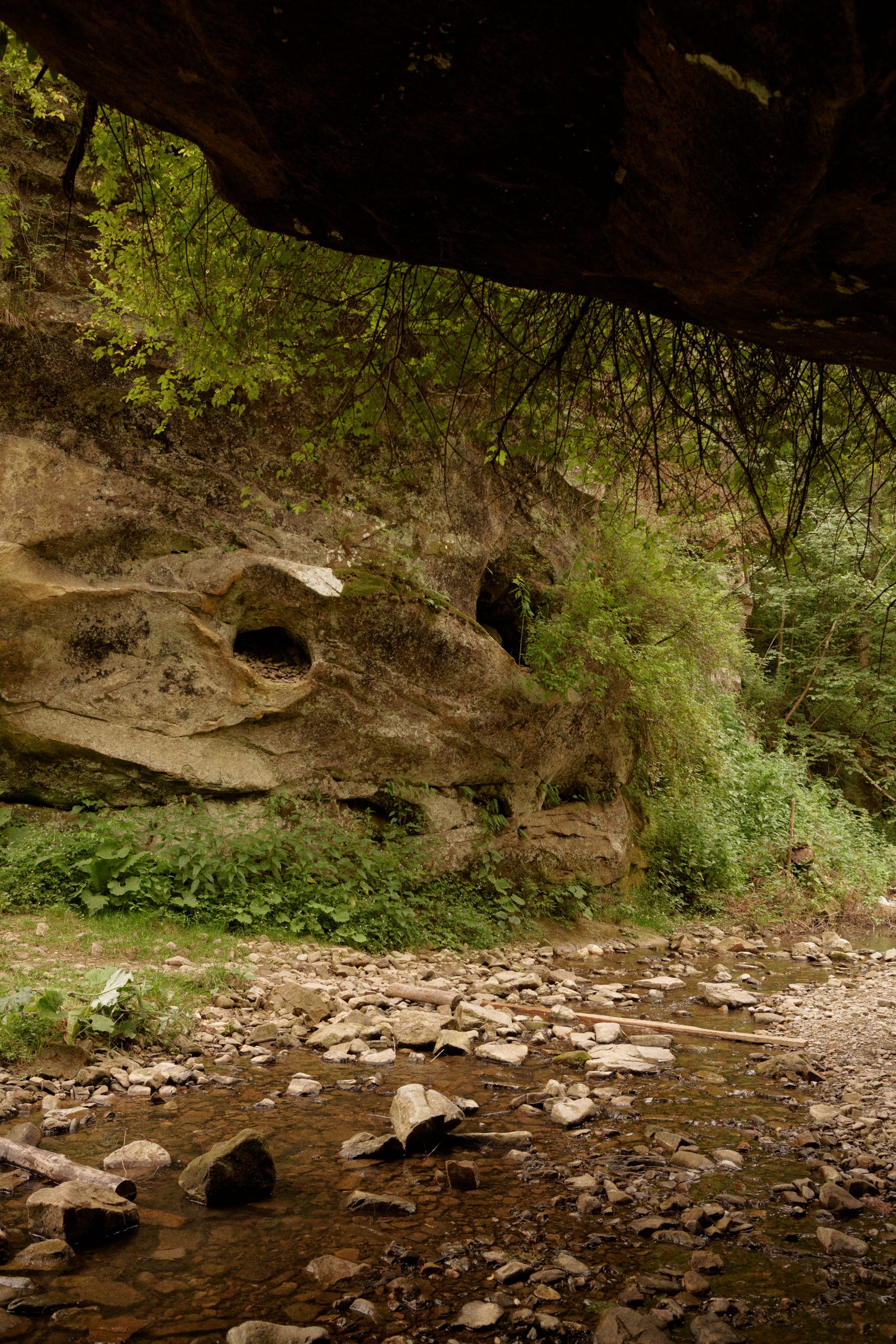
The legends are only part of the story. To understand why huge boulders stand here, it helps to look at the stone through a geologist’s eyes — a story far older than any sanctuary.
The flysch Carpathians
Ternoshory lies in the Pokuttya-Bukovynian Carpathians, a mountain system built of flysch: layered marine sediments in which hard sandstones alternate with softer siltstones, mudstones and marls. As the mountains rose, these layers were folded and thrust over each other.
Yamna sandstone
Local and geological sources describe the Ternoshory boulders as Yamna sandstone, a light-grey, durable rock of Paleocene age — tens of millions of years old. Because it resists weathering, it often forms rocky ridges and isolated outcrops. The chain of outcrops at Ternoshory stretches for about 300 m, with individual rocks up to about 40 m high according to various descriptions.
How the rocks appeared
Erosion exposed them. Water and frost wore away the softer layers faster, leaving the hard blocks standing. The Bezulka stream cut into the slope and formed a valley with a river terrace; geologist O. Stelmakh, as cited by Mykola Kuhutiak, estimated it at about 11,000 years old. Where the stream crosses hard beds you find waterfalls such as Ternoshorskyi Huk and pools like the Nymphs’ Pool.
Age of the stone vs. age of the legends
- Rock age: tens of millions of years — sandstone formed from ancient sea sediments.
- Landscape age: much younger — uplift and erosion exposed the rocks.
- Human presence: the least certain. Mykola Kuhutiak, whose expedition studied the site in 2006–2007, interprets it as an ancient rock sanctuary. Popular claims of “40,000 years” have no published dating evidence in accessible sources, so we present them only as a version.
Read more in Historical Landmark and see photos of the rocks.